In the golang community slack, someone shared a link to a package used to validate Swedish personnumer. Personnumer is a swedish version of an ID, and its format is well defined:
- or
+.For example 19900101-0017
Here is the initial code of the package:
package personnummer

import (
    "math"
    "reflect"
    "regexp"
    "strconv"
    "time"
)

// luhn will test if the given string is a valid luhn string.
func luhn(str string) int {
    sum := 0

    for i, r := range str {
        c := string(r)
        v, _ := strconv.Atoi(c)
        v *= 2 - (i % 2)
        if v > 9 {
            v -= 9
        }
        sum += v
    }

    return int(math.Ceil(float64(sum)/10)*10 - float64(sum))
}

// testDate will test if date is valid or not.
func testDate(century string, year string, month string, day string) bool {
    t, err := time.Parse("01/02/2006", month+"/"+day+"/"+century+year)

    if err != nil {
        return false
    }

    y, _ := strconv.Atoi(century + year)
    m, _ := strconv.Atoi(month)
    d, _ := strconv.Atoi(day)

    if y > time.Now().Year() {
        return false
    }

    return !(t.Year() != y || int(t.Month()) != m || t.Day() != d)
}

// getCoOrdinationDay will return co-ordination day.
func getCoOrdinationDay(day string) string {
    d, _ := strconv.Atoi(day)
    d -= 60
    day = strconv.Itoa(d)

    if d < 10 {
        day = "0" + day
    }

    return day
}

// Valid will validate Swedish social security numbers.
func Valid(str interface{}) bool {
    if reflect.TypeOf(str).Kind() != reflect.Int && reflect.TypeOf(str).Kind() != reflect.String {
        return false
    }

    pr := ""

    if reflect.TypeOf(str).Kind() == reflect.Int {
        pr = strconv.Itoa(str.(int))
    } else {
        pr = str.(string)
    }

    re, _ := regexp.Compile(`^(\d{2}){0,1}(\d{2})(\d{2})(\d{2})([\-|\+]{0,1})?(\d{3})(\d{0,1})$`)
    match := re.FindStringSubmatch(pr)

    if len(match) == 0 {
        return false
    }

    century := match[1]
    year := match[2]
    month := match[3]
    day := match[4]
    num := match[6]
    check := match[7]

    if len(century) == 0 {
        yearNow := time.Now().Year()
        years := [...]int{yearNow, yearNow - 100, yearNow - 150}

        for _, yi := range years {
            ys := strconv.Itoa(yi)

            if Valid(ys[:2] + pr) {
                return true
            }
        }

        return false
    }

    if len(year) == 4 {
        year = year[2:]
    }

    c, _ := strconv.Atoi(check)

    valid := luhn(year+month+day+num) == c && len(check) != 0

    if valid && testDate(century, year, month, day) {
        return valid
    }

    day = getCoOrdinationDay(day)

    return valid && testDate(century, year, month, day)
}
Let’s add a benchmark:
func BenchmarkValid(b *testing.B) {
    for i := 0; i < b.N; i++ {
        Valid("19900101-0017")
    }
}
Results:
$ go test -bench=BenchmarkValid$ -benchmem
goos: darwin
goarch: amd64
pkg: github.com/ngalayko/go
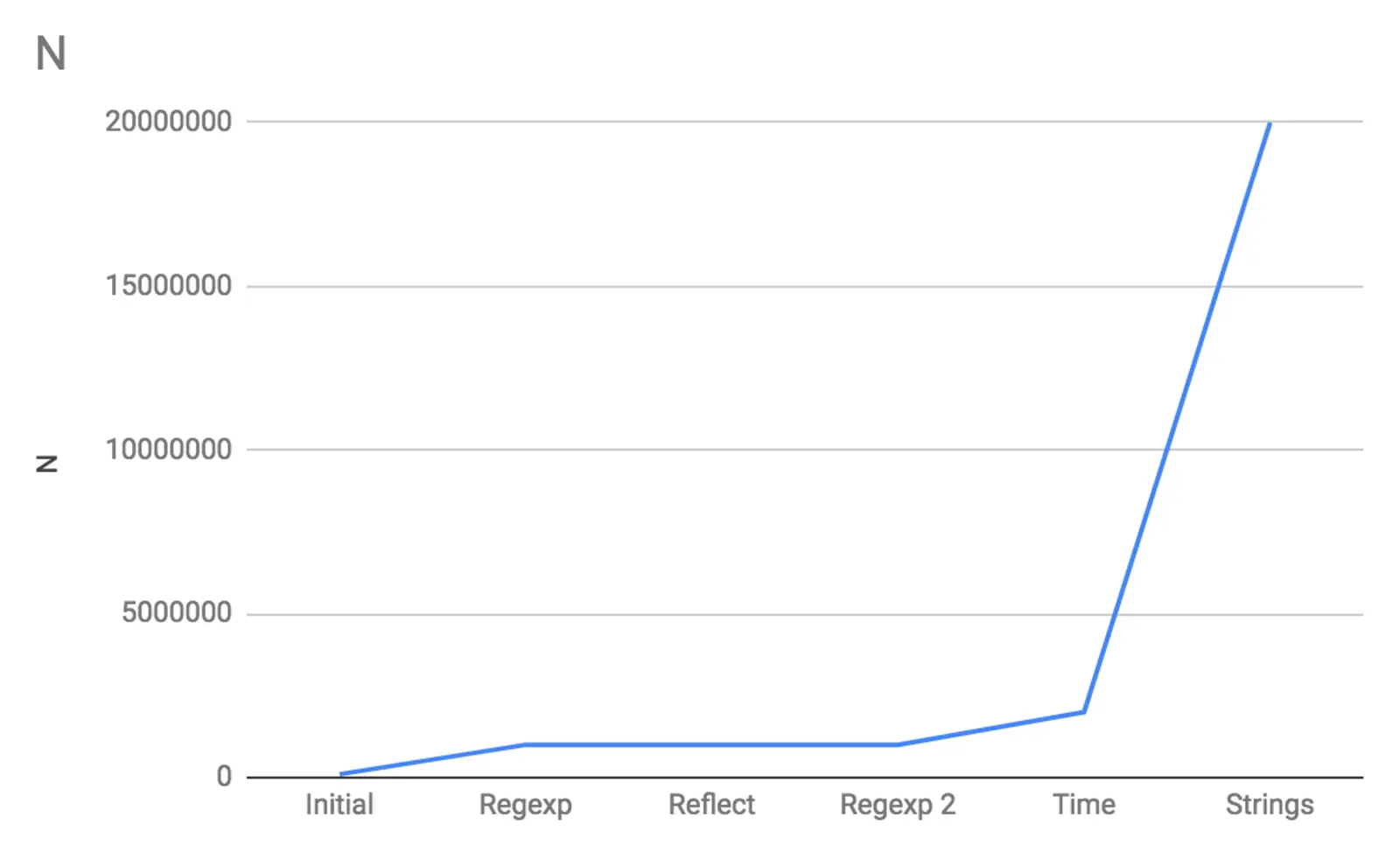
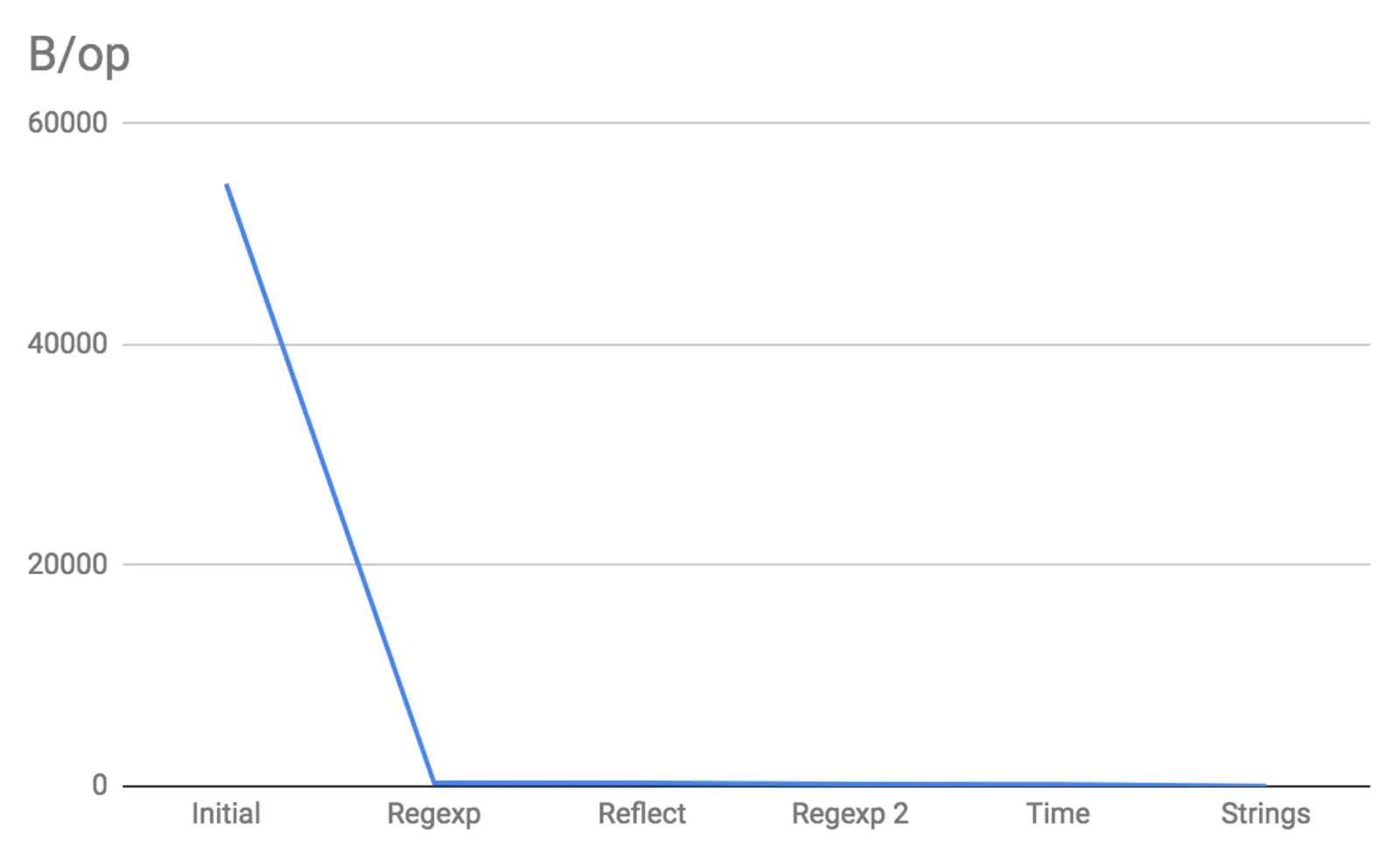
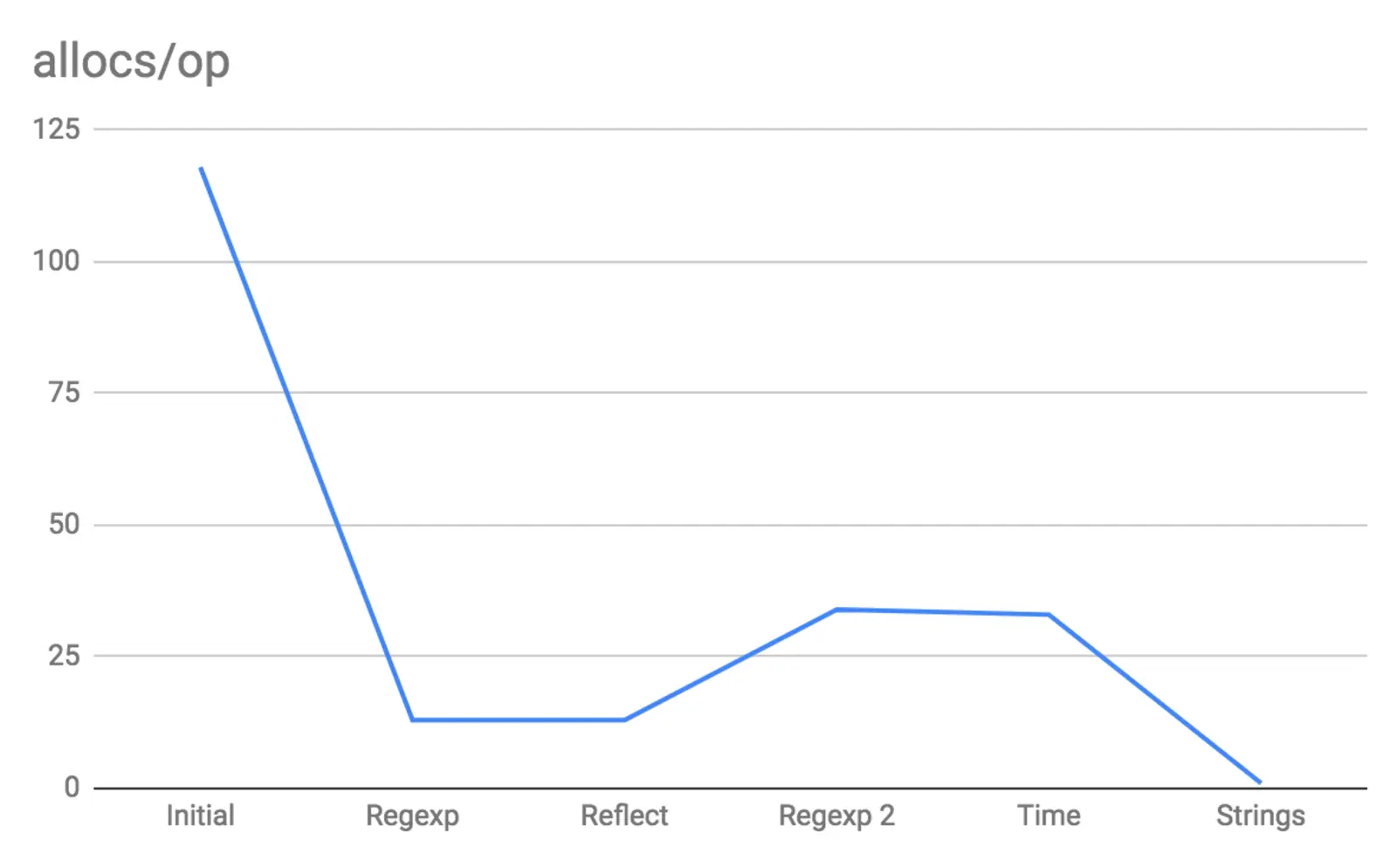
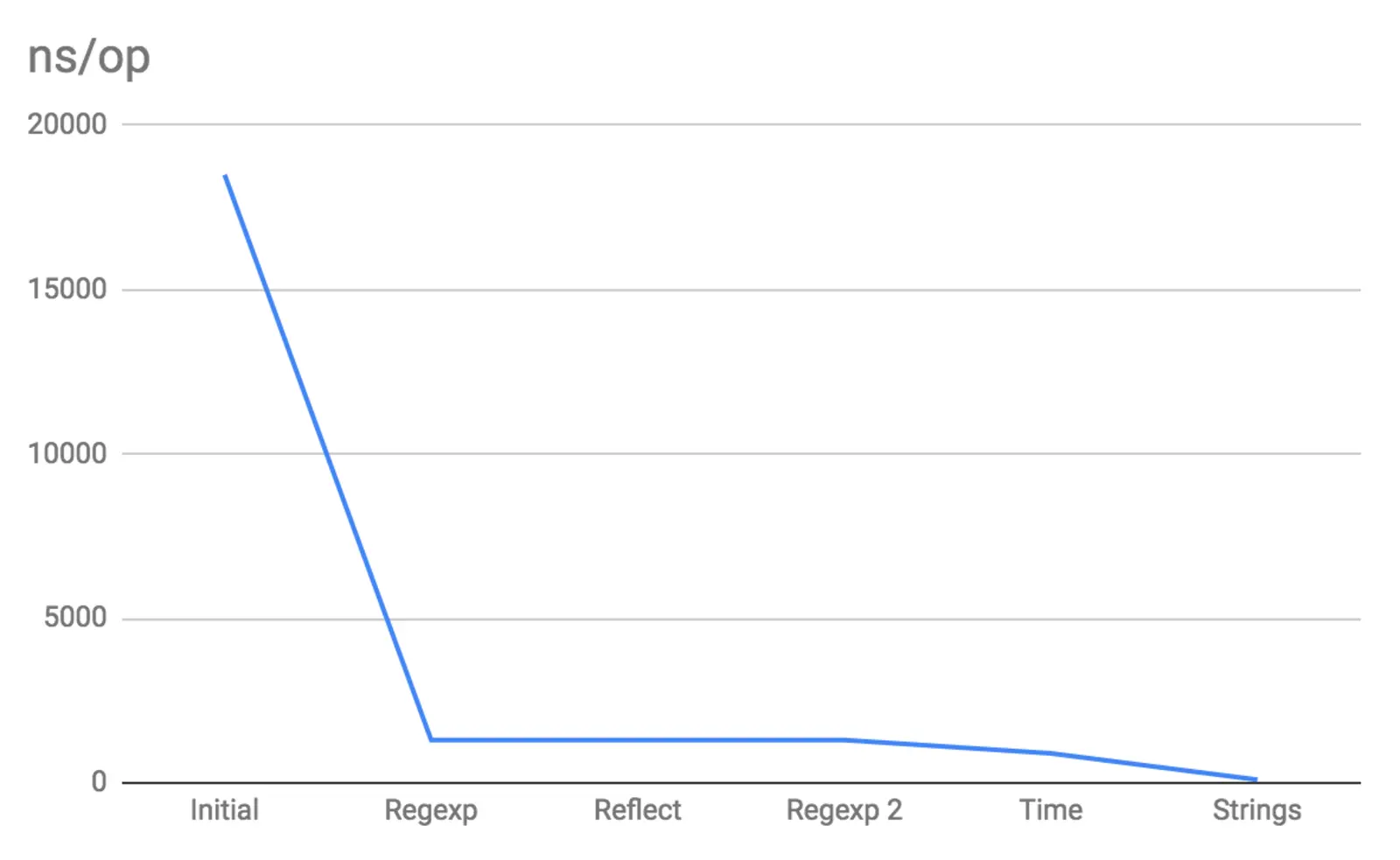
BenchmarkValid-4  100000  18498 ns/op  54576 B/op  118 allocs/op
PASS
That’s a lot of resources to validate a string using four simple rules.
There are several problems in the code. I am going to remove it one by one:
The most popular way to optimize functions in go is to move the regexp compilation out from a function:
var (
    re = regexp.MustCompile(`^(\d{2}){0,1}(\d{2})(\d{2})(\d{2})([\-|\+]{0,1})?(\d{3})(\d{0,1})$`)
)

// Valid will validate Swedish social security numbers.
func Valid(str interface{}) bool {
    //...

    match := re.FindStringSubmatch(pr)

    //...
}
Results are not surprising:
$ go test -bench=BenchmarkValid$ -benchmem
goos: darwin
goarch: amd64
pkg: github.com/ngalayko/go
BenchmarkValid-4  1000000  1301 ns/op  309 B/op  13 allocs/op
PASSReflection is generally slow and is not made to be used in such
cases. Here it is used to check if the input type in int or
string. Let’s assume we actually need a function that
accepts an interface, and not just a string.
To check the type of an interface you don’t need a reflect package. You can always switch on an interface type:
// Valid will validate Swedish social security numbers.
func Valid(i interface{}) bool {
    switch v := i.(type) {
    case int, int32, int64, uint, uint32, uint64:
        return ValidString(fmt.Sprint(v))
    case string:
        return ValidString(v)
    default:
        return false
    }
}

// ValidString will validate Swedish social security numbers.
func ValidString(s string) bool {
    // ...
}
Results are pretty much the same. I think it’s because of some
compiler optimizations where switch v.(type) is syntax
sugar for reflect.TypeOf(v), plus undercover all objects
know what types they are even when you use them as an
interface{}.
$ go test -bench=BenchmarkValid$ -benchmem
goos: darwin
goarch: amd64
pkg: github.com/ngalayko/go
BenchmarkValid-4  1000000  1305 ns/op  309 B/op  13 allocs/op
PASSWhy do we even need a regexp package here? To validate that string
contains only digits and - or - regexp is an
overkill.
First, we clean out everything except digits from a string and check it’s length because we know what that length should be (6+4 or 8+4).
To check if a character is a digit, it’s enough to make sure that
it’s greater than '0' and less than '9',
because all digits have sequential codes in the (ASCII
table)[http://www.asciitable.com/].
func ValidString(s string) bool {
    cleanNumber := ""
    for _, c := range s {
        if c == '+' { // `+` is allowed, but we don't need it.
            continue
        }
        if c == '-' { // `-` is allowed, but we don't need it.
            continue
        }

        if c > '9' {
            return false
        }
        if c < '0' {
            return false
        }

        cleanNumber += string(c)
    }
    //...
}
And once we have a string that has only digits, it’s easy to get all parts of it:
    //...

    var (
        century string
        year    string
        month   string
        day     string
        num     string
        check   string
    )

    switch len(cleanNumber) {
    case 10:
        year = string(cleanNumber[:2])
        month = string(cleanNumber[2:4])
        day = string(cleanNumber[4:6])
        num = string(cleanNumber[6:9])
        check = string(cleanNumber[9:])
    case 12:
        century = string(cleanNumber[:2])
        year = string(cleanNumber[2:4])
        month = string(cleanNumber[4:6])
        day = string(cleanNumber[6:8])
        num = string(cleanNumber[8:11])
        check = string(cleanNumber[11:])
    default:
        return false
    }

    //...
Results are a bit better:
$ go test -bench=BenchmarkValid$ -benchmem
goos: darwin
goarch: amd64
pkg: github.com/ngalayko/go
BenchmarkValid-4  1000000  1302 ns/op  208 B/op  34 allocs/op
PASSStandard time package is great, but what we need here is just simple validation of a date:
var monthDays = map[int]int{
    1:  31,
    3:  31,
    4:  30,
    5:  31,
    6:  30,
    7:  31,
    8:  31,
    9:  30,
    10: 31,
    11: 30,
    12: 31,
}

// testDate will test if date is valid or not.
func testDate(century string, year string, month string, day string) bool {
    y, err := strconv.Atoi(century + year)
    if err != nil {
        return false
    }
    m, err := strconv.Atoi(month)
    if err != nil {
        return false
    }
    d, err := strconv.Atoi(day)
    if err != nil {
        return false
    }

    if m != 2 {
        days, ok := monthDays[m]
        if !ok {
            return false
        }
        return d <= days
    }

    leapYear := y%4 == 0 && y%100 != 0 || y%400 == 0

    if leapYear {
        return d <= 29
    }
    return d <= 28
}
Benchmark:
$ go test -bench=BenchmarkValid$ -benchmem
goos: darwin
goarch: amd64
pkg: github.com/ngalayko/go
BenchmarkValid-4   2000000  901 ns/op  192 B/op  33 allocs/op
PASSNotice that there are still 33 allocations per function call. Where
do they come from? It’s because we use string type all the
time, string is the same thing as a []byte,
but immutable. So every time we call
cleanNumber += string(c), allocation happens. It’s
impossible to change the string, so new the string is allocated, and
both strings are copies there.
Let’s remove string usage:
package personnummer

import "fmt"

const (
    lengthWithoutCentury = 10
    lengthWithCentury    = 12
)

// ValidateStrings validate Swedish social security numbers.
func ValidString(in string) bool {
    cleanNumber := make([]byte, 0, len(in))
    for _, c := range in {
        if c == '+' {
            continue
        }
        if c == '-' {
            continue
        }

        if c > '9' {
            return false
        }
        if c < '0' {
            return false
        }

        cleanNumber = append(cleanNumber, byte(c))
    }

    switch len(cleanNumber) {
    case lengthWithCentury:
        if !luhn(cleanNumber[2:]) {
            return false
        }

        dateBytes := append(cleanNumber[:6], getCoOrdinationDay(cleanNumber[6:8])...)
        return validateTime(dateBytes)
    case lengthWithoutCentury:
        if !luhn(cleanNumber) {
            return false
        }

        dateBytes := append(cleanNumber[:4], getCoOrdinationDay(cleanNumber[4:6])...)
        return validateTime(dateBytes)
    default:
        return false
    }
}

var monthDays = map[int]int{
    1:  31,
    3:  31,
    4:  30,
    5:  31,
    6:  30,
    7:  31,
    8:  31,
    9:  30,
    10: 31,
    11: 30,
    12: 31,
}

// input time without centry.
func validateTime(time []byte) bool {
    length := len(time)

    date := charsToDigit(time[length-2 : length])
    month := charsToDigit(time[length-4 : length-2])

    if month != 2 {
        days, ok := monthDays[month]
        if !ok {
            return false
        }
        return date <= days
    }

    year := charsToDigit(time[:length-4])

    leapYear := year%4 == 0 && year%100 != 0 || year%400 == 0

    if leapYear {
        return date <= 29
    }
    return date <= 28
}

// Valid will validate Swedish social security numbers.
func Valid(i interface{}) bool {
    switch v := i.(type) {
    case int, int32, int64, uint, uint32, uint64:
        return ValidString(fmt.Sprint(v))
    case string:
        return ValidString(v)
    default:
        return false
    }
}

var rule3 = [...]int{0, 2, 4, 6, 8, 1, 3, 5, 7, 9}

// luhn will test if the given string is a valid luhn string.
func luhn(s []byte) bool {
    odd := len(s) & 1

    var sum int

    for i, c := range s {
        if i&1 == odd {
            sum += rule3[c-'0']
        } else {
            sum += int(c - '0')
        }
    }

    return sum%10 == 0
}

// getCoOrdinationDay will return co-ordination day.
func getCoOrdinationDay(day []byte) []byte {
    d := charsToDigit(day)
    if d < 60 {
        return day
    }

    d -= 60

    if d < 10 {
        return []byte{'0', byte(d) + '0'}
    }

    return []byte{
        byte(d)/10 + '0',
        byte(d)%10 + '0',
    }
}

// charsToDigit converts char bytes to a digit
// example: ['1', '1'] => 11
func charsToDigit(chars []byte) int {
    l := len(chars)
    r := 0
    for i, c := range chars {
        p := int((c - '0'))
        for j := 0; j < l-i-1; j++ {
            p *= 10
        }
        r += p
    }
    return r
}
Final result:
$ go test -bench=BenchmarkValid$ -benchmem
goos: darwin
goarch: amd64
pkg: github.com/ngalayko/go
BenchmarkValid-4  20000000  94.0 ns/op  16 B/op  1 allocs/op
PASS
If you have an idea how to improve it more, please share.